

Group 5 · Right of way at intersections: who goes first
Updated
This chapter is a short summary of the official rules. If anything here differs from the official text, the official text prevails: see the official sources.
What this topic covers on the exam
Almost every question in Group 5 · Right of way at intersections is a drawing or photo of an intersection: which vehicle goes first, second or last, or whom you must give way to. The topic is part of the Rules of the Road (Rules), and 15 of the 20 knowledge-test questions are on the Rules (RA Government Decision No. 385-N of March 26, 2020, Annex 1, point 17). To answer, you need chapter X of the Rules, points 86.1–101, the priority signs 2.1–2.5 (Rules, Form No. 1) and a few definitions from the Law "On Ensuring Road Traffic Safety" (Law).
Key terms
- Intersection: an area where roads cross, join or branch at the same level. Leaving an adjacent area (a yard, parking lot, filling station and so on) onto a road is not an intersection (Law, Article 2).
- Give way: don't continue or resume moving, or make any maneuver, if that may force other drivers to change direction or speed unexpectedly (Law, Article 2).
- Main road: a road marked with signs 2.1, 2.3.1–2.3.11 or 5.1 relative to the road it crosses or joins; a paved road (asphalt concrete, cement concrete, stone and so on) relative to a dirt road; any road relative to a road leaving adjacent areas (Rules, point 3(1)).
Step 1: regulated or unregulated?
- An intersection is regulated when the order of passage is set by a traffic controller or traffic lights (Rules, point 89). If traffic lights contradict priority signs, follow the lights (Rules, point 173). A controller's signals must be obeyed even if they contradict lights, signs or markings (Rules, point 20). Regulated intersections are covered in Group 6 · Traffic light and traffic controller signals.
- An intersection is unregulated when there is no traffic light or controller, the light isn't working, or it shows flashing yellow (Rules, points 7(4), 95). Then the next three sections apply.
Unequal roads
- A driver approaching on the secondary road gives way to vehicles on the main road, whatever direction they will take next (Rules, point 96).
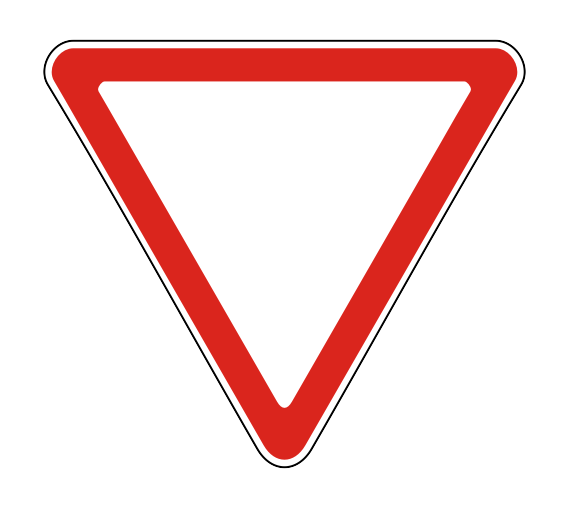
- With sign 2.4 "Give way", give way to vehicles on the crossing road or, with plate 8.13 "Direction of the main road", on the main road. Sign 2.5 "No driving without stopping" requires the same, but first stop before the stop line or, if there is none, before the edge of the crossed roadway (Rules, Form No. 1, signs 2.4, 2.5).
- If the main road changes direction at the intersection, drivers on the main road apply the equal-road rules to each other. Drivers on the secondary roads do the same among themselves (Rules, point 97).
- If you can't tell whether a road is paved (dark time of day, mud, snow and so on) and there are no priority signs, assume you are on the secondary road (Rules, point 101).
Equal roads
- A driver of a non-rail vehicle gives way to vehicles approaching from the right. Tram drivers follow the same rule among themselves (Rules, point 98).
- When turning left or making a U-turn, give way to vehicles coming from the opposite direction on the equal road that are going straight or turning right (Rules, point 99).
- At such an intersection a tram has priority over non-rail vehicles whatever its direction (Rules, points 98, 100). At an intersection of unequal roads, a tram has the same priority over non-rail vehicles moving in the same or opposite direction on a road of equal rank (Rules, point 96).
Roundabouts
- When entering a roundabout marked with sign 4.3 "Roundabout", you must give way to vehicles already moving around it (Rules, point 98.1). This is the exception written into point 98: the right-hand rule doesn't apply here.
- Sign 1.7 "Intersection with a roundabout" warns that one is ahead (Rules, Form No. 1, section 1).
Other rules at intersections
- Approach at a speed that lets you stop and let through vehicles that have priority (Rules, point 86.1).
- When leaving the intersection after a right or left turn, don't obstruct pedestrians crossing the roadway, and give way to cyclists on a bicycle path (Rules, point 87).
- Don't enter an intersection if a jam ahead would force you to stop and block vehicles on the crossing road, except when turning right or left as the Rules allow (Rules, point 88).
- To get priority, the driver of a vehicle with a blue flashing beacon must switch on both the beacon and the special sound signal (Rules, point 26). When such a vehicle approaches, give way to it (Rules, point 28).
Typical exam traps
- A sign and a working traffic light. The light wins over the priority sign (Rules, point 173). With flashing yellow or a light that's off, the intersection is unregulated and the signs apply (Rules, point 95).
- Turning along a bending main road. Drivers on the secondary roads give way to you; with other main-road drivers you use the equal-road rules (Rules, points 96, 97).
- A paved stretch on a dirt road just before the intersection. It doesn't make the dirt road equal to the paved road it crosses (Rules, point 3(1)).
- The right-hand rule at a roundabout. With sign 4.3 you give way to vehicles already on the roundabout (Rules, point 98.1).
- A tram at an equal intersection. It goes first whatever its direction, even when it approaches from your left (Rules, point 98).
- An ambulance without its signals. Without both the blue beacon and the special sound signal, it has no priority (Rules, point 26).
- Leaving a yard. That's not an intersection, and any road is the main road relative to it (Law, Article 2; Rules, point 3(1)).
- A jam beyond the intersection. Going straight in is prohibited if you'd have to stop and block crossing traffic (Rules, point 88).
Checklist
- Is there a working traffic light or a controller (Rules, points 20, 89, 95, 173)?
- Which road is the main one: signs, surface or an exit from an adjacent area (Rules, points 3(1), 101)?
- Does the main road bend (Rules, plate 8.13, point 97)?
- On equal roads: who is on your right, and are you turning left or making a U-turn (Rules, points 98, 99)?
- Is there a tram (Rules, points 96, 98, 100)?
- Is it a roundabout with sign 4.3 (Rules, point 98.1)?
- After the turn: pedestrians, cyclists, a jam ahead (Rules, points 87, 88)?