

Group 7 · Stopping, parking and road markings
Updated
This chapter is a short summary of the official rules. If anything here differs from the official text, the official text prevails: see the official sources.
What this topic covers on the exam
Most questions in Group 7 of the official question bank come with a picture: may you stop or park here, who broke the rules, what does this marking mean?
The topic comes from the Rules of the Road (Rules: RA Government Decision No. 955-N of June 28, 2007, Annex 1). Of the 20 knowledge-test questions, 15 are on the Rules of the Road.
Stopping and parking
Definitions from Article 2 of the Law "On Ensuring Road Traffic Safety" (Law):
- Stopping: deliberately bringing a vehicle to a standstill for up to 5 minutes, or for as long as passengers need to get in or out or the vehicle needs to be loaded or unloaded.
- Parking: a deliberate standstill of more than 5 minutes for other purposes.
- Forced stop: for example, because of a fault, a hazard, a prohibiting signal or giving way. The rules on stopping don't apply to it.
Where you may stop
- On the right side of the road, next to the sidewalk or on the shoulder; if there is neither, at the edge of the roadway (Rules, point 78).
- In built-up areas, on the left side: on roads with one lane in each direction and no tram tracks in the middle, and on one-way roads. On a one-way road, trucks with a maximum permissible mass over 3.5 t may only stop there to load, unload or let passengers in or out (Rules, point 79).
- Only cars, motorcycles, mopeds and bicycles may park on the edge of the sidewalk, and only where sign 6.4 "Parking" has one of plates 8.6.2, 8.6.3, 8.6.6–8.6.9 (Rules, point 81).
- Outside built-up areas, long rest or overnight parking is allowed only in designated areas or off the road (Rules, point 82).
Stopping is prohibited
Rules, point 84:
- on sidewalks (except in the cases of point 61), and on or near tram tracks if it obstructs trams;
- on railway crossings, in tunnels, and on and under overpasses, bridges and viaducts;
- where less than 3 m would remain between the vehicle and a solid line (other than the roadway edge line), a median strip, the opposite edge of the roadway or an obstacle;
- on pedestrian crossings and less than 5 m before them;
- near dangerous bends and hill crests where visibility is under 100 m in at least one direction;
- at intersections and less than 5 m from the edge of the crossing roadway (with an exception for three-way junctions);
- at a public transport stop marked with line 1.17, or, without that marking, less than 15 m from the signs of a public transport stop or taxi stand;
- where the vehicle would hide traffic lights or signs or otherwise block visibility.
Public transport vehicles may not stop outside their stops, except for a forced stop (Rules, point 85).
Parking is prohibited
- wherever stopping is prohibited, on the roadway of roads marked with sign 2.1 "Main road" outside built-up areas, and less than 50 m from railway crossings (Rules, point 86);
- in residential zones and in yards enclosed by residential buildings: with the engine running, and, for trucks over 3.5 t and buses (except minibuses), outside designated places (Rules, points 121, 122).
When a railway crossing is closed, stop at the stop line, sign 2.5 or the traffic light; without them, at least 5 m from the barrier, and without a barrier, at least 10 m from the nearest rail (Rules, point 111).
Signs
Rules, Form No. 1:
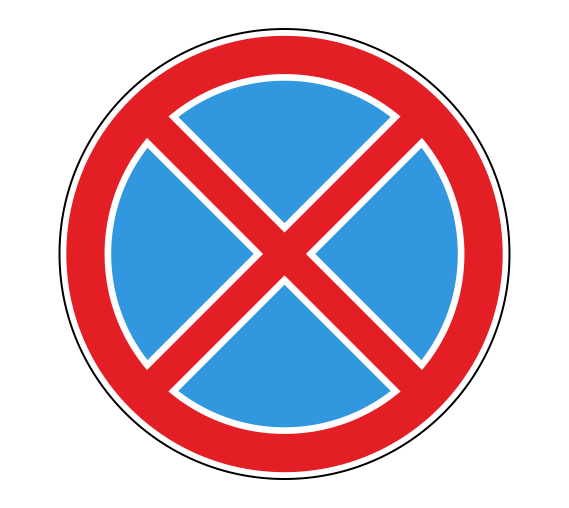
- 3.27 "No stopping" prohibits stopping and parking; 3.28 "No parking" prohibits parking only. 3.29/3.30 prohibit parking on odd/even days of the month; where both are used, vehicles move to the other side between 19:00 and 21:00.
- Signs 3.27–3.30 apply only to the side of the road where they stand, up to the nearest intersection (in a built-up area without intersections, to its end). When 3.27 is used with line 1.4, or 3.28 with line 1.10, the zone equals the length of the marking.
- 3.28–3.30 don't apply to vehicles driven by or carrying certain persons with disabilities (as listed in Form No. 1), to special postal vehicles with a postal color scheme, or to taxis with the meter on. 3.27 has no such exceptions. A sign with plate 8.18 "Except persons with disabilities" doesn't apply to vehicles with the "Person with a disability" identification sign.
Road markings
Permanent horizontal markings are white, except yellow 1.4, 1.10, 1.17 and 1.26; temporary markings are orange (Rules, point 170). If temporary and permanent markings conflict, follow the temporary ones (Rules, point 174). Vertical markings are stripes on road structures that show their outline (Rules, point 171).
Horizontal markings (Rules, Form No. 2):
- 1.1 solid line, 1.2 roadway edge line, 1.3 double solid on roads with 4 or more lanes.
- 1.4 yellow solid: no stopping or parking; 1.10 yellow dashed: no parking (at the roadway edge or on the curb).
- 1.6 approach line: 1.1 or 1.11 ahead; 1.8 wide dashed: acceleration or deceleration lane; 1.9: reversible lanes.
- 1.13: where to give way; 1.15: bicycle path crossing; 1.17 yellow zigzag: public transport stop (with sign 5.18, a taxi stand).
- 1.19 arrows: lane ends or 1.1/1.11 ahead; 1.23: public transport lane; 1.25: speed bump.
Crossing lines (Rules, Form No. 2):
- 1.1, 1.2 and 1.3 may not be crossed, except 1.1 where it marks parking spaces (to enter or leave them) and 1.2 to stop on the shoulder and pull away where stopping is allowed.
- 1.5–1.8 may be crossed from either side.
- 1.11 may be crossed from the dashed side, and from the solid side when finishing overtaking or going around an obstacle.
Other vehicles may not drive or stop in a public transport lane. If it is separated by a dashed line, you may enter it to drop off or pick up passengers or to turn, giving way to public transport (Rules, point 124).
Typical exam traps
- Dropping off a passenger is stopping, so it is prohibited under sign 3.27 or along line 1.4 (Law, Article 2; Rules, Forms No. 1 and 2).
- 2.5 m to a solid line is less than 3 m: no stopping (Rules, point 84).
- Railway crossing: stopping is prohibited on the crossing, parking also within 50 m (Rules, points 84, 86). Two bank questions give 25 m or 15 m instead.
- A taxi with the meter on may park under 3.28, but not under 3.27 (Rules, Form No. 1).
- A truck of up to 3.5 t may not park on the sidewalk edge: it isn't on the point 81 list (Rules, point 81).
Quick checklist
- Stopping: up to 5 minutes, or passengers and loading; parking: longer.
- Numbers: 3, 5, 15, 50 and 100 m; 5 m from a barrier, 10 m from a rail.
- 3.27 and 1.4: stopping and parking; 3.28 and 1.10: parking only.
- 1.1–1.3 aren't crossed, 1.5–1.8 are, 1.11 from the dashed side.
Official sources
- RA Government Decision No. 955-N of June 28, 2007, Annex 1 (Rules of the Road), points 78–86, 111, 121–122, 124, 170–171, 174, Form No. 1 (signs 3.27–3.30, plate 8.18) and Form No. 2 (road markings)arlis.am (opens in a new tab)
- Law "On Ensuring Road Traffic Safety", Article 2 (stopping, parking, forced stop)arlis.am (opens in a new tab)